Herculaneum from Naples
Twenty minutes down the line, the other buried town makes the counter-argument: smaller than Pompeii, deeper-buried, better-preserved — wooden beams, upper floors, and two hours that outweigh six.
The short version
- The Circumvesuviana from Napoli Porta Nolana/Garibaldi reaches Ercolano Scavi in 20–25 minutes on ordinary fares — trains run frequently, crowded, and famously ungently; the operator’s info at eavsrl.it. From the station, the walk downhill to the gate takes ten minutes, the site opening below you as you go.
- Herculaneum died differently than Pompeii — buried deeper by pyroclastic surges that carbonized rather than crushed — so wooden beams, doors, staircases, and upper floors survive here that exist nowhere else.
- Entry runs in the mid-teens of euros with timed online purchase available; the site’s compactness is the feature — a quarter of Pompeii’s sprawl at several times its preservation density.
- The essentials: the House of the Neptune Mosaic’s glass-paste colors, the Hall of the Augustals’ frescoes, the wooden screen in the House of the Wooden Partition, and the thermopolia counters still ringed with serving jars.
- The boathouses along the ancient shoreline hold casts and remains of some three hundred people who died awaiting rescue — presented by the site as the human record it is, presented factually and without spectacle — give them the quiet minute they call for
- Vesuvius pairs from the same station: shuttle buses climb to the crater path, whose timed tickets sell online in advance — the alarm’s reserve-before-you-leave rule, because the mountaintop sells out and the ticket office is an internet page.

Getting there
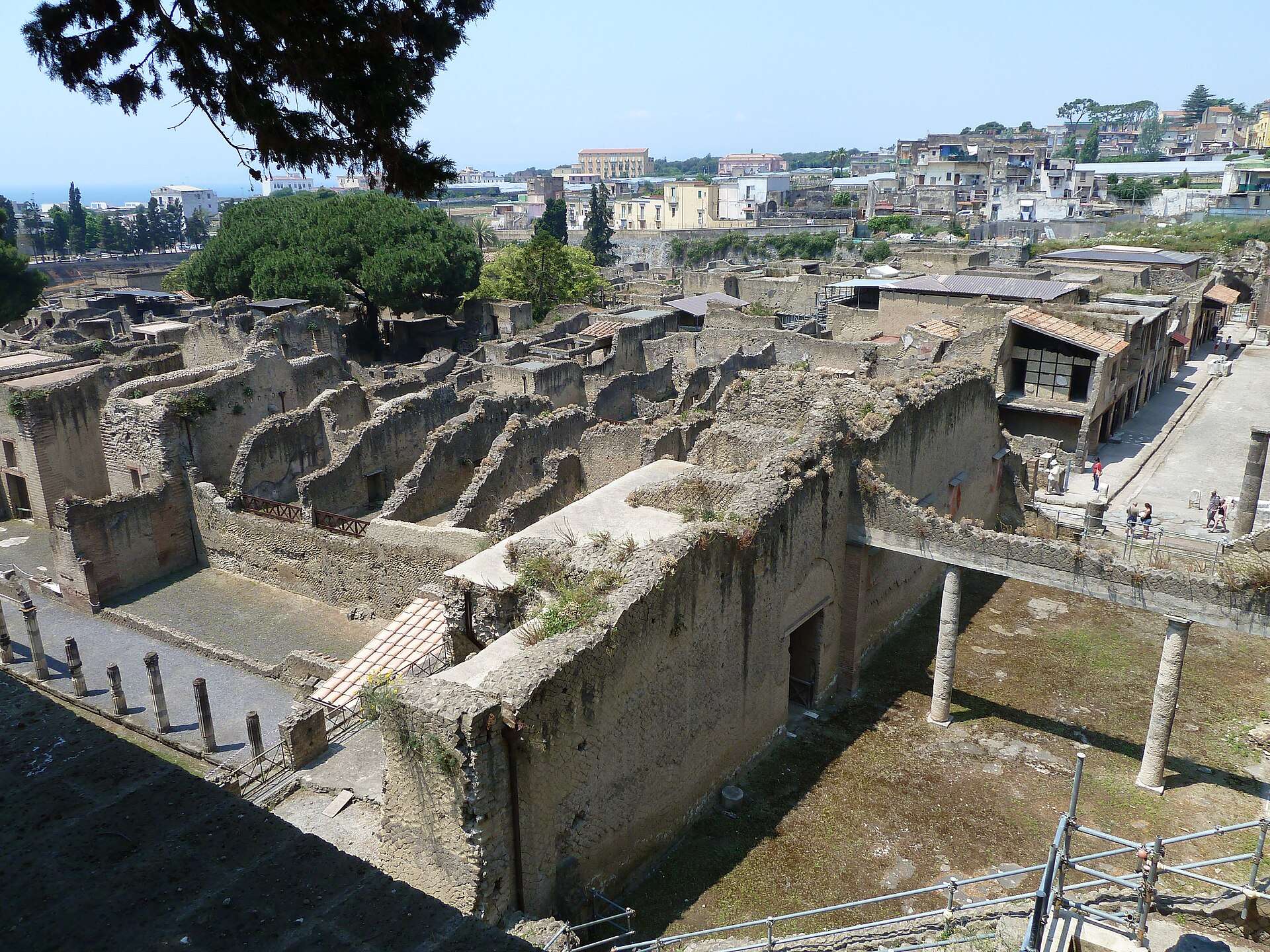
The Circumvesuviana is Naples’ workhorse — buy at the machine, guard your pockets by habit rather than fear, and count the stops to Ercolano Scavi. The downhill approach street runs straight at the site; the terrace before the ticket gate gives you the entire town in one look, Vesuvius behind it, which no map matches. Pompeii-bound travelers pass the same station eight minutes later — the two-site day exists (this network’s Pompeii coverage handles that giant) but each wants its own energy; the clear choice with one morning is here.
The visit
Enter across the walkway over the old shoreline — the boathouses first, taken with the seriousness the alarm set, because they anchor everything above them in fact. Then up into the grid: the Cardo streets’ houses with their second stories and carbonized fittings, the Neptune mosaic’s improbable blues, the baths’ intact benches and shelving, the bakery’s mills and the bar counters mid-service. The site reads as interrupted domesticity rather than ruin, which is its particular power and why two focused hours outweigh a sprawling six elsewhere. The audio guide or a licensed guide converts good to excellent; the on-site bookshop’s plans serve the self-directed. Exit uphill for a sfogliatella by the station, or transfer allegiance to the Vesuvius shuttle if the crater booking says so.
When to go
The site works year-round — its partial shade and compact scale forgive summer better than Pompeii does, though spring and autumn remain the humane windows. Winter offers low light in the fresco rooms and near-solitude midweek. First Sundays run free and correspondingly full. Vesuvius add-ons live by mountain weather: the crater path closes in wind and cloud, refunding nothing, so the pairing favors settled forecasts and the season’s early starts.
Frequently Asked Questions
Herculaneum or Pompeii if I can only do one?
Time-poor or preservation-minded: here — the survival of wood, floors, and color gives the closest thing to walking into 79 AD that exists. Scale-minded or first-time-in-the-region: Pompeii’s vastness has its own force. This network documents both; doing either well beats doing both badly.
What happened to the people in the boathouses?
Some three hundred residents sheltered in the waterfront vaults awaiting evacuation by sea; the first surge killed them instantly. Excavated in the 1980s–90s, the remains rewrote the assumption that most had escaped. The site presents them factually and without spectacle, and visitors follow its lead.
How does the Vesuvius add-on work in practice?
Shuttle services from Ercolano Scavi station climb to the park entrance at around 1,000 meters; the timed crater ticket — booked online in advance, per the alarm — admits you to the rim path, about 30 minutes up a gravel grade. Half a day total, real shoes, and the weather rules are absolute.
Is the modern town worth any time?
Ercolano’s Via Mare corridor and market streets are working Naples-adjacent life, plus the Vesuvian villas of the Golden Mile for Bourbon-era contrast. Most day-trippers rightly spend their hours below ground level; the sfogliatella stop is the sensible compromise.
What can’t I see here?
Much of ancient Herculaneum remains unexcavated under the modern town — including most of the famous Villa of the Papyri, whose library scrolls are still being virtually unrolled by particle accelerator. The best finds live in the Naples Archaeological Museum, which makes the city-museum pairing the scholar’s version of this trip.